
By the time an owner builder gets to the garden, the money is usually gone. The slab cost more than the estimate, the roof took longer, and the landscaping line in the budget has been raided twice.
The good news is that a garden, unlike a kitchen, can be built in stages, and most of what makes a new build look finished is cheap.
This guide, by Isaac Olson at Nursery Near Me, is about where the money matters and where it doesn’t, in any part of mainland Australia.
What a new build site is really like
Owner builders inherit a site that has been scraped, driven over and used as a storage yard for a year. Expect:
– Compacted subsoil with the topsoil pushed into a heap or carted away.
– Builders’ sand, mortar droppings and gravel in the first few centimetres.
– A hard pan where the site cut was made, and fill where it was levelled.
– Pipes, conduits and the stormwater line close to the surface near the house.
None of that’s a reason to spend big. It’s a reason to spend first on soil and last on plants.
Where to spend
1. Soil preparation
This is the one job that is cheaper to do before anything else and expensive to do afterwards.
Hire a rotary hoe or a small excavator for a day, break the compaction to a spade’s depth, remove the rubble, and spread the topsoil heap back over the beds. Compost dug in now does more than any fertiliser bought later.
A soil test from your state agriculture department or a garden centre costs little and tells you whether to add lime or gypsum before planting.
2. Drainage and levels
Water needs somewhere to go.
Grade the ground away from the slab, put in an agricultural drain where water collects, and keep garden beds below the damp course. Fixing a wet corner after the garden is in means digging the garden up.
3. The structure you touch every day.
A path from the car to the door, one level outdoor space big enough for a table, and a tap at each end of the block.
These three things make a half finished garden usable, and they are the hardest to add later.
4. One good tree
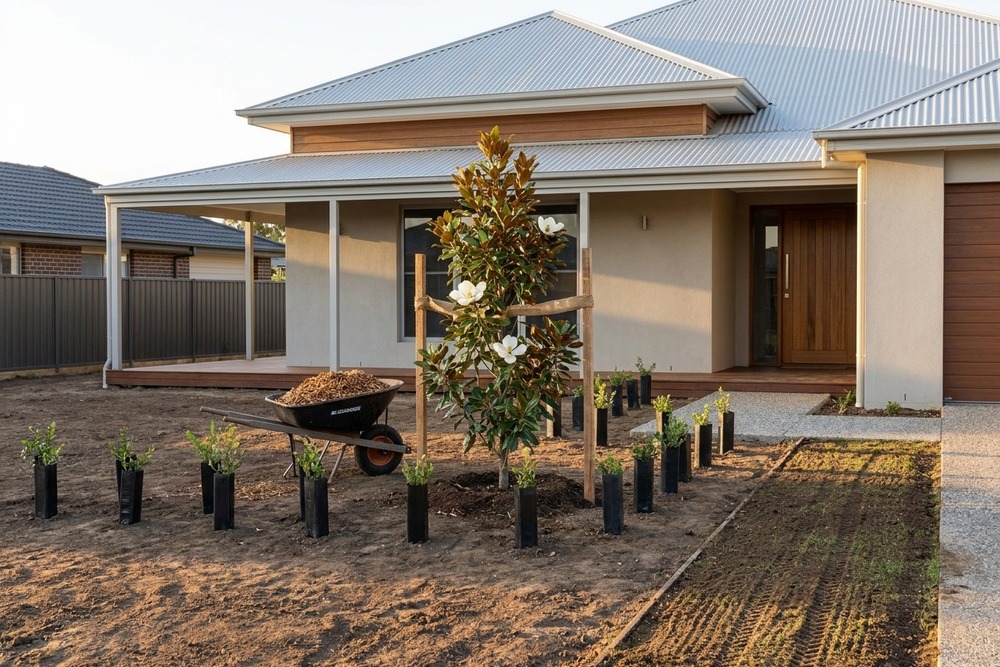
A single well placed tree does more for a new build than a hundred small plants: it shades the western wall, hides the neighbour’s roof and makes the house look settled.
Spend on the tree, not on the pot size. A tree planted as a two year old plant will usually overtake a mature one planted the same day within three or four seasons, because it establishes without the shock.
Where to save
1. Buy small plants
This is the biggest saving in the whole garden.
Tubestock, the small plants nurseries grow in forestry tubes, costs a fraction of advanced stock and establishes faster because the roots are young.
Our tubestock range is where most of our own orders for new gardens start, and the same plants are available as advanced stock for the few spots where you need size on day one.
2. Mass plant a few species
A bed of twenty of one plant reads as a design. A bed of twenty different plants reads as a clearance sale.
Pick three or four tough plants for the whole block, buy them in multiples and repeat them. It’s cheaper to buy, easier to maintain and looks like someone planned it.
3. Mulch from the tree loppers
Most arborists will drop a load of woodchip for free or for the cost of the truck. It is coarser than bagged mulch and better for the soil.
Keep it a hand’s width off every stem and well away from the house walls in a bushfire area.
4. Lawn from seed, not roll
Where you want lawn at all, seed in autumn or spring costs a tenth of turf and is established by the following summer.
Keep the lawn small; it’s the most expensive part of a garden to run.
5. Skip the irrigation system for now
A new garden planted in autumn or spring with a good soak twice a week in its first summer will establish on a hose and a timer tap. Put the dripline in later, once you know where the plants are staying.
The order of work
1. Grade, drain and prepare the soil while the machinery is still on site.
2. Paths, the outdoor level space and the taps.
3. The tree, in autumn or spring.
4. Hedges and screens, as small plants, where you need privacy.
5. Mass planting of the beds.
6. Lawn, pots and the finishing plants, when the budget recovers.
Each stage is useful on its own. A graded, mulched block with a path and one tree is a garden that will wait a year for the rest without looking abandoned.
Plants that forgive a tight budget
The plants that cost least to run are the ones that need nothing after the first summer.
In a year of our own orders across Australia, the quality gardeners asked for more than any other was low maintenance, and the plants they bought most were natives: lilly pilly for hedges, compact native daisies for colour, tussock grasses for the gaps, coastal rosemary and dwarf bottlebrush for shrubs.
All of them take pruning, poor soil and a dry spell. Match the plant to your climate and soil rather than to the picture, and check the care guide before you order, because a plant that dies in the first summer is the most expensive plant you can buy.
A note on planting near the house
Keep large shrubs and trees well back from the slab, the sewer line and the stormwater pits, and check your bushfire attack level before planting anything oily or fine leaved near the walls.
The clearances for pipes and the clearances for fire usually point to the same answer: open ground near the house, structure further out.
Conclusion
Landscaping a new build on a budget is a matter of order.
Spend on the soil, the drainage, one tree and the few pieces of structure you use daily, then buy small, buy fewer kinds and plant in autumn or spring.
The garden will take two or three seasons to look finished, which is about as long as it takes an owner builder to recover from the house.
Frequently asked questions
1. How much of the landscaping budget should go on plants?
Less than most people expect. In a tight budget the soil preparation, drainage and hard surfaces take most of the money; plants bought small are the cheapest part.
2. Is tubestock really worth it on a new build?
Yes, for almost everything except the one or two plants you need at full size immediately. Small plants establish faster, cost far less and can be planted in the numbers a new block needs.
3. When is the best time to plant a new garden in Australia?
Autumn, then spring, in every mainland state. Avoid planting in December and January in a new garden with no shade; the first summer is what kills new plants, and an autumn planting gets a whole winter of root growth before it arrives.
Author bio
Isaac Olson is a director of Nursery Near Me, an Australian online nursery that delivers plants, trees and hedging to every mainland state and publishes more than 300 free plant care guides at nurserynearme.com.au.