
Building your own home is one of the biggest projects you’ll ever take on. For some people, handing everything over to a volume builder feels right. For others, the idea of having more control, more transparency and more involvement is incredibly appealing.
But wanting more control and knowing how to manage a build properly are two very different things.
Danny Assabgy has spent decades inside the construction industry, leading a high-volume building company, Hudson Homes, delivering hundreds of homes each year. Through that experience, he saw something interesting – many capable, organised people had the potential to manage their own builds successfully but the systems, structure and safeguards available to professional builders simply weren’t accessible to them.
That insight led to the creation of Build Buddy and what Danny calls “collaborative construction”, a structured middle ground between the traditional builder model and going it completely alone.
In this conversation, Danny shares what really causes projects to derail, why trades often hesitate to work with owner builders, and what it actually takes to run a smoother, safer and more predictable build.
Key Takeaways from Danny
- There are three ways to build – traditional builder, owner builder, and what Danny calls collaborative construction, which sits in the middle.
- Most build failures come down to sequencing and poor planning, not the physical construction itself.
- Trades don’t dislike owner builders – they dislike disorganisation. Clear plans and locked-in decisions make all the difference.
- A bill of quantities is non-negotiable if you want to properly track your budget and to communicate clearly with suppliers.
- Plan slowly so you can build quickly. The success of your build is determined long before the slab is poured.
- Build Buddy is best suited to organised, proactive people willing to follow a structured process.
Danny, tell us a bit about your background and how you ended up building a platform like Build Buddy.
I’ve been in the construction industry for a long time. For the past 15 years I’ve been CEO of Hudson Homes – we’re a volume builder in NSW and Queensland, doing five to six hundred homes a year.
We were awarded Australian Builder of the Year in 2015, and I was also awarded CEO of the Year for the building and construction industry.
Through that lens, I saw the complexity, the cost, and the sheer administrative weight of traditional building. And I could also see this growing group of people who had the drive to manage their own builds but they didn’t have the tools or access to the information they needed.
What do you mean by “collaborative construction”? How is it different to owner building?
What we created is something we call collaborative construction and that’s the core idea behind Build Buddy.
I always say there are three ways to build:
- The traditional builder approach
- The owner builder approach
- What we do is the overlap between the two – that overlap is collaborative construction.
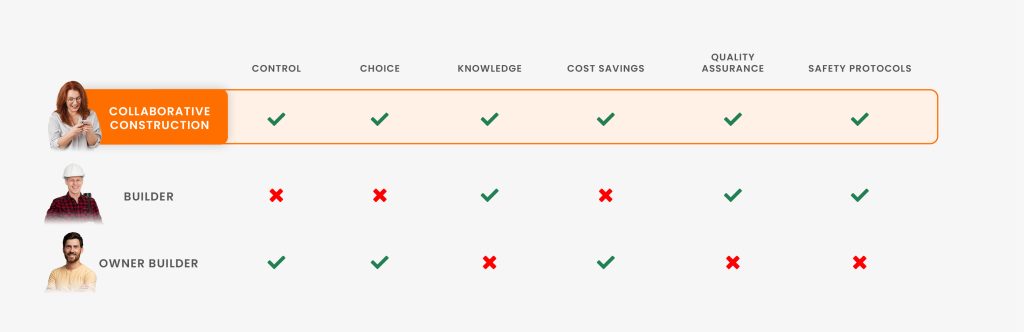
It takes it away from the idea that you’re the owner who’s totally in control and alone. Instead, you’re doing it collaboratively with all the stakeholders – trades, architect, bank – everyone working off the same set of information, on the same platform.
Owner building isn’t all roses and sunshine, there are real pitfalls. This model is designed to reduce them.
What inspired you to create Build Buddy?
It was actually a phone call from a customer.
At Hudson Homes, if you walk into any display home you’ll see a flyer with my head on it and my phone number and it basically says, “If anything happens, call me.” Because yes, 150 things go wrong in every build. But what matters is what the company does when things go wrong.
So a customer rings me and at the end of the call he says, “Mate, I can do a better job building my house than what you guys can do.”
And I thought about it, and I said, “I’ve got hundreds of homes to look after. You’ve got one. And it’s the most important home ever because it’s yours.”
When I got off that call, it hit me. A lot of people could do a better job with their own home if they had the right structure around them.
You mentioned you didn’t start out as a builder. How did that shape your approach?
My background isn’t originally building. I went to uni and studied accounting, law and finance. I ended up getting my builder’s licence later because I got sick of people telling me, “What do you know about building?”
But I do think it gave me a different lens. I started asking: what value does a builder actually add? And I narrowed it down to three big things:
- Process and workflow – knowing the sequence, the 300–400 steps, what comes first and what can’t happen until something else happens.
- Trade relationships and supply agreements – the database of trusted trades and suppliers.
- On-site expertise – and this is where a lot of people fall down when they try to manage a build.
A little bit of knowledge can be very dangerous. The moment you think you know more than someone with 20–30 years experience, you likely don’t.
What are the biggest mistakes you see when people manage their own build?
Two big ones.
First, people think they know more than they do. That’s common.
But the most common mistake is underestimating sequencing and the domino effect it has. If the plumber is late, the slab is delayed, and suddenly the whole timeline is blown out.
The second major pitfall is poor budget tracking. People rely on basic spreadsheets and they don’t properly account for variations, provisional sums, hidden costs – those words builders and trades love.
Honestly, it’s not just the physical building work that trips people up, it’s the administrative and scheduling oversight.
Why do trades often avoid working with owner builders?
I learnt this early.
When I first started Build Buddy, I leaned on our Hudson Homes trade base. I remember showing one of our electricians in Queensland, Tim, the Build Buddy idea. He said, “Danny, I’ll do anything for you, but please don’t give me an owner builder.”
He told me why. Last time he did one, he walked onto a job at frame stage. There were no electrical drawings and the owner’s walking around saying, “put a Powerpoint there, add lights here…”
Trades don’t want that. They want to work off a set of plans. They want to schedule properly, order the right products, direct their team, and not redo things 100 times. Nothing upsets a professional trade more than making it up as you go.
That’s why we built safety nets into Build Buddy because trades need structure as much as homeowners do.
Can you give a simple example of the kind of “safety net” you mean?
Sure.
We had a lady ready to start construction, but the system wouldn’t let her proceed because she hadn’t selected her shower taps.
She said, “That’s ridiculous. I don’t need them for another six months.”
But here’s what happens if you don’t.
The plumber roughs in for standard hot/cold taps, waterproofing goes in, tiles go on… then you go to Harvey Norman and pick a $300 mixer tap you love.
Off come the tiles. Off comes the waterproofing. Everything gets redone. And $10,000 later, you’ve installed your $300 tap.
People don’t realise that. Sequencing matters.
The platform also prevents you from booking the bricklayer if it knows the bricks aren’t on site.
Because if the brickie turns up and there’s no bricks, they’re not going to be happy and you may never see them again.
So how does Build Buddy actually help someone stay organised and in control?
The first thing we say is – you’re in control, but you’re never alone.
Build Buddy acts like your digital site supervisor and project manager rolled into one.
It centralises everything – scheduling, budgets, communication, documentation. It keeps records of scope of works, what’s been agreed to, variations, and stores it in a document library that the right people can access.
And it makes communication more efficient.
Traditionally, if an owner needs to ask a carpenter something, it goes through head office, customer service, site supervisor… back and forth. On our platform, there is no middle man, owners deal directly with trades seamlessly with real-time documentation, scope of works, variations, quality checklists and so on… everything is easily kept track of.
It also updates schedules in real time. If anything changes, it automatically updates the future tasks downstream, also auto-updating the dates for relevant trades you’ve engaged.
So you’re not second guessing the next step.
You’ve mentioned a “construction buddy” a few times. What is that, and is it optional?
We believe that every successful build should have a site supervisor on the job – an expert set of eyes that can foresee issues before they get bad. We believe they are an essential trade – just like a plumber or electrician!
Of course, as the owner builder, you completely choose if you want this and how much involvement you would want them to have. Build Buddy has this simplified with tiers.
There are three levels:
Tier 1: For people who’ve built before and don’t want supervision. This is focused on quality of works completed so far, but also importantly safety on site. They get seven independent site safety inspections across the build.
Site safety is not negotiable. You don’t want to get caught out unprepared, with a random safety inspection from the government!
Tier 2: Tier 2 is basically an advisory service. This tier is common for someone with some experience, maybe you are a tradie or have owner-built before. It is having your own personal site supervisor on speed-dial.
They essentially do the same inspection reports as tier 1, but they will give you ongoing advice throughout your build. You can of course ask them up-front if you want them to come out to site more regularly. We find people on tier 2 often ask for 1 weekly site visit.
Tier 3: The tier 3 Construction Buddy is the most popular selection with our owner builders. It allows them to still have a life because they have the support of a site supervisor to help them coordinate the trades and problem solve.
For Hudson Homes, I always have an experienced site supervisor allocated to every job, so why should it be any different for an owner builder? I personally believe that a Construction Buddy is the secret sauce to any owner builder having a successful build.
When should someone start using a system like Build Buddy, at what stage?
Earlier is better.
We’ve split the workflows into two: pre-construction and construction.
When someone enrols, they go through a wizard, about 5 to 7 questions, and depending on where they’re at (just an idea, plans, DA approval, etc.) the platform generates their first task.
If you’ve just bought land, for example, one of the first things is understanding site constraints.
People often want to go straight to an architect but architects need a canvas. So you need a survey first.
The system helps you request quotes with a proper scope of works because if it’s your first build, you don’t know what to ask for, what needs to be shown on drawings.
That quote request connects to the trade side of the platform – Build Buddy Pro.
What is Build Buddy Pro?
The easiest way to explain it is like Uber.
There are two Uber apps: one for the passenger and one for the driver.
Same with Build Buddy.
Build Buddy is for homeowners. Build Buddy Pro is for service providers – electricians, plumbers, carpenters, and so on. When a homeowner requests a quote, it goes to the relevant pros.
Uber has one category – drivers. We’ve got 112 trade categories. Even within one trade, there are variations like different types of electricians. Some do solar, some don’t. Pros choose the categories they cover.
That’s a big part of the collaboration – everyone can see the schedule, whether it’s calendar view, Gantt chart view, or list view. Shared information, one source of truth.
How does the platform help with budget overruns and keeping costs under control?
The first question I ask is: what is “over” and how do you even know your starting point?
A builder will never commence a job without two things:
- Construction-ready set of plans
- A bill of quantities
A bill of quantities itemises everything – down to screws and linear metres – and allocates costs.
Our platform prompts people to get one through a professional estimator, then it’s uploaded into Build Buddy and mapped against your project spending so you can see your budget in real time.
But one of the most powerful parts is the payment system. We use a digital wallet setup through a bank – think of it like a trust account.
Because in construction, there’s this rule: he who has the gold rules.
If the customer holds the money, trades worry they won’t get paid. If the trade gets paid upfront, good luck getting them back on site quickly.
So we use milestone payments. The homeowner allocates the funds for that milestone into the trade’s wallet – the trade can see it’s there, but they can’t touch it. They do the work, mark it complete, and the homeowner (or construction buddy) checks a quality checklist. Then the payment is released.
If it’s not right, a defect is raised. If it can’t be resolved, we help dispute resolution but the key is the money stays held until it’s resolved.
And because all payments are tracked, the platform shows whether you’re under or over budget per cost code and it becomes very obvious, very quickly, where the blowouts are coming from.
Where do you see technology making the biggest difference in construction?
The building industry is probably the worst when it comes to technological advancement.
Everything else has been disrupted but not building. Technology creates a level playing field.
Historically, only high-volume builders had the software to procure materials efficiently, schedule trades, and track costs. Now, technology gives everyday homeowners that same power in the palm of their hand.
It takes something that’s overwhelming and makes it more streamlined.
Who is Build Buddy best suited for?
I originally built the platform with the school teacher or police officer husband-and-wife team in mind – capable, organised people with no building background who wanted more involvement in their project.
But I’ll be honest, it’s not for everyone. In fact, I’d say 80% of people are better off going through a traditional builder. There’s about 20% where this model is a great fit.
Build Buddy is best suited to someone who’s highly organised, proactive and wants transparency and control. You don’t need to be a builder or have a trade background. You just need to communicate well and be willing to follow a structured process.
What’s your one piece of advice for someone considering managing their own build?
100% it’s plan slowly, build quickly.
Plan meticulously before you start. The success of your build is determined long before the site is fenced off.
Invest heavily in pre-construction: get your plans right, get your selections finalised. Pick the shower taps so no decisions are made on site.
When you respect the planning process, the build phase becomes significantly less stressful and much more rewarding.
Mistakes happen when you’re standing there on site going, “Oh, where does this colour go?”
Then you repaint, there’s a variation, and suddenly everyone’s frustrated.
Do what professional builders do. There’s a reason builders charge you to make changes to plans because decisions need to be locked in on documentation.
About Danny
Danny has spent more than 15 years leading Hudson Homes, a high-volume residential builder delivering hundreds of homes each year across New South Wales and Queensland. Under his leadership, the company was awarded Australian Builder of the Year, and Danny was recognised as CEO of the Year for the building and construction industry.
With a background in accounting, law and finance, Danny brings a strategic lens to construction – combining process, structure and financial discipline with practical building expertise. His experience running large-scale building operations revealed both the strengths and limitations of traditional construction models.
Danny is the Founder of Build Buddy, a platform designed to bring professional-level systems, workflow and financial controls into the hands of everyday homeowners through what he calls “collaborative construction.” His mission is simple – create better processes, reduce risk, and empower capable people to build smarter.